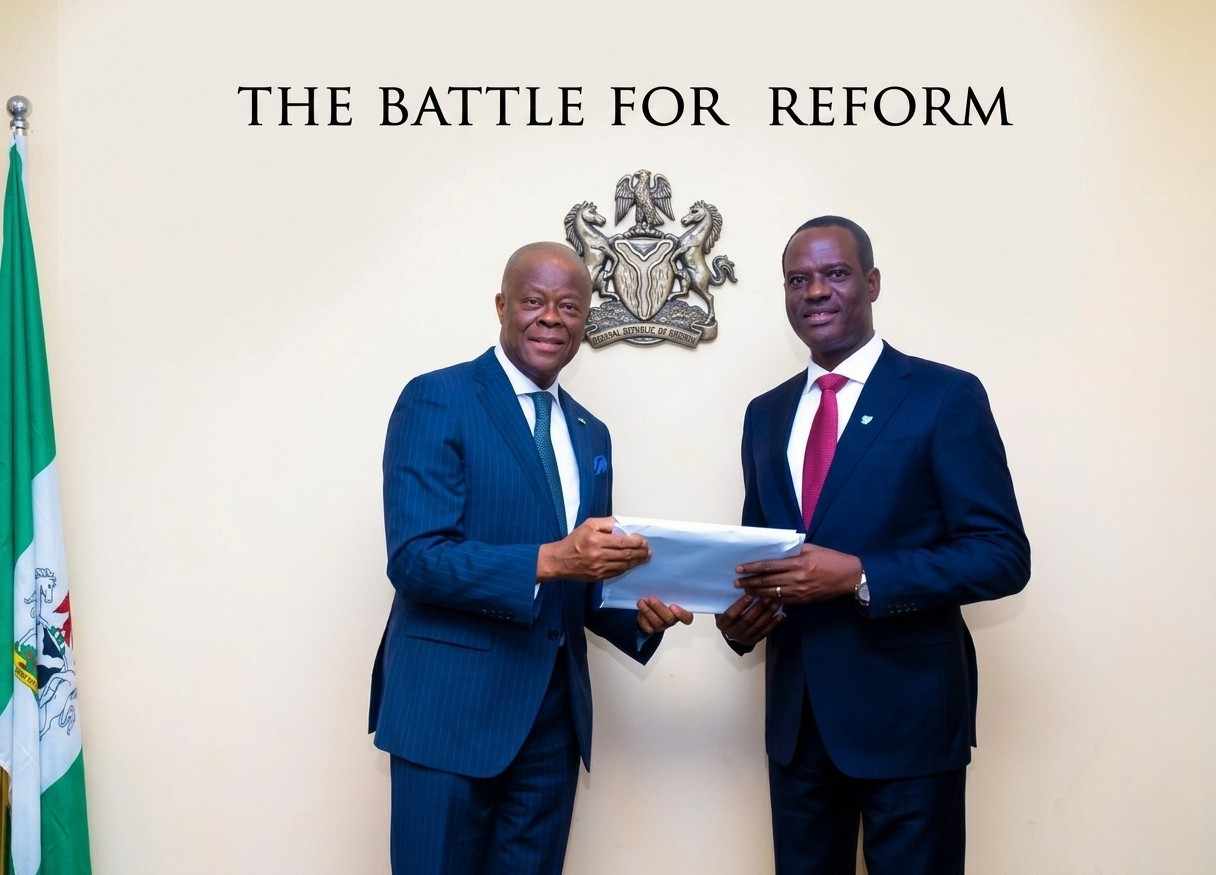
While the political elite in Abuja were busy choreographing Wale Edun’s “graceful exit” on his 70th birthday, a far more ominous number was being etched into the ledgers of the Debt Management Office (DMO). By the close of the 2025 fiscal year, Nigeria’s total public debt stock had surged to an unprecedented ₦159.28 trillion. To the average Nigerian, this figure is so large it becomes an abstraction—a collection of zeros on a spreadsheet. But in reality, it is a heavy, invisible ceiling that is currently crushing the life out of the country’s economic recovery.
The transition from Wale Edun to Taiwo Oyedele isn’t just a change of personnel; it is a desperate attempt to manage a “Debt-Revenue Mismatch” that has reached its breaking point. For years, Nigeria has been borrowing to pay interest on previous borrowings. We have entered the “Debt Trap,” and the walls are closing in.
The Anatomy of the N159 Trillion Shadow
The composition of this ₦159 trillion debt is a cocktail of past mistakes and current crises. Roughly ₦98 trillion of this is domestic debt—money owed to local banks, institutional investors, and the securitized “Ways and Means” advances that Edun fought so hard to stop. The remaining ₦61 trillion is external debt, largely denominated in US Dollars.
Herein lies the “Currency Trap.” Because Edun insisted on a market-reflective exchange rate, every time the Naira dipped against the Dollar in 2025, the “Naira value” of our external debt ballooned without the government borrowing an extra cent. This created a situation where the Ministry of Finance was effectively running up a treadmill that was moving faster than its ability to pay. Investigative data from the “Amina” desk shows that by February 2026, Nigeria was spending nearly 74% of its total revenue just to service interest on these debts. This leaves only 26% of every Naira earned to build roads, pay soldiers, fund schools, and run the entire machinery of government.
The “Invisibility of Progress” on the Streets
The most tragic part of the ₦159 trillion figure is how it translates to the streets of Lagos, Kano, and Port Harcourt. To the Nigerian citizen, the “fiscal discipline” Edun preached felt like a cruel joke. While he was being praised in London for stopping the “Ways and Means” money printing, the lack of liquidity on the ground led to a stagnant economy.
When the government stops “printing” and the “revenue” hasn’t arrived, the first thing to suffer is the social safety net. In early 2026, the “Bread-and-Butter Index” reached a crisis point. Inflation, fueled by the 2025 energy shocks and the lingering impact of the subsidy removal, meant that the average family was spending 85% of their income on food alone. The “Investigative Context” we have gathered from grassroots market associations suggests that the “Edun Reform” became synonymous with “The Great Squeeze.” People were told they were being “saved” from hyperinflation, but they were being “suffocated” by the cost of living.
The Sinking Fund and the Moral Hazard
As revealed in Part 3, the final standoff between Edun and the Villa was over the ₦4.2 trillion Debt Sinking Fund. This fund was supposed to be the “insurance policy”—a pot of money set aside specifically to pay back the principal on maturing bonds. By attempting to raid this fund for “intervention projects,” the political class was essentially suggesting that the government eat its “seed corn” to survive the winter.
The investigative reality is that the Presidency felt it had no choice. With the 2027 elections appearing on the horizon, the prospect of another year of “fiscal austerity” was politically unpalatable. They needed to show “physical progress”—new bridges, commissioned hospitals, and social handouts. But doing so by weakening the Sinking Fund sends a terrifying signal to international creditors. It says that Nigeria is no longer prioritizing its long-term creditworthiness over its short-term political survival.
From Edun’s “Guardrails” to Oyedele’s “Taxman”
This debt mountain is exactly why the “Oyedele Era” has begun with such a sharp focus on taxation. Edun tried to solve the debt problem by cutting spending and stopping the printing presses. It was a “Supply-Side” approach that ultimately failed because the political pressure for spending was too high.
Taiwo Oyedele’s mandate is the opposite: he is not there to cut spending; he is there to find the money to fund it. The pivot is from “Fiscal Restraint” to “Revenue Aggression.” The target is a massive ₦40.7 trillion in revenue for 2026. For the average Nigerian, this means that the “Squeeze” is moving from the macro level to the micro level. If you own a shop, if you drive a car, if you use digital services—the “Oyedele Taxman” is coming to collect.
The High-Stakes Gamble
The ₦159 trillion debt is the “Ghost of Christmas Past” that continues to haunt the present. The transition to Oyedele is a gamble that Nigeria can “tax its way out” of a debt trap that “spending cuts” couldn’t solve. But there is a ceiling to how much a struggling population can be taxed before the social contract snaps.
As we move into Part 5, we will look at the “Future of the Ledger”—the ₦40.7 trillion revenue target and whether Taiwo Oyedele can succeed where Wale Edun was forced to retire. The debt hasn’t gone away; it has simply changed owners. And for the 200 million Nigerians watching their wallets shrink, the only question that matters is: “Who is going to pay for all of this?”