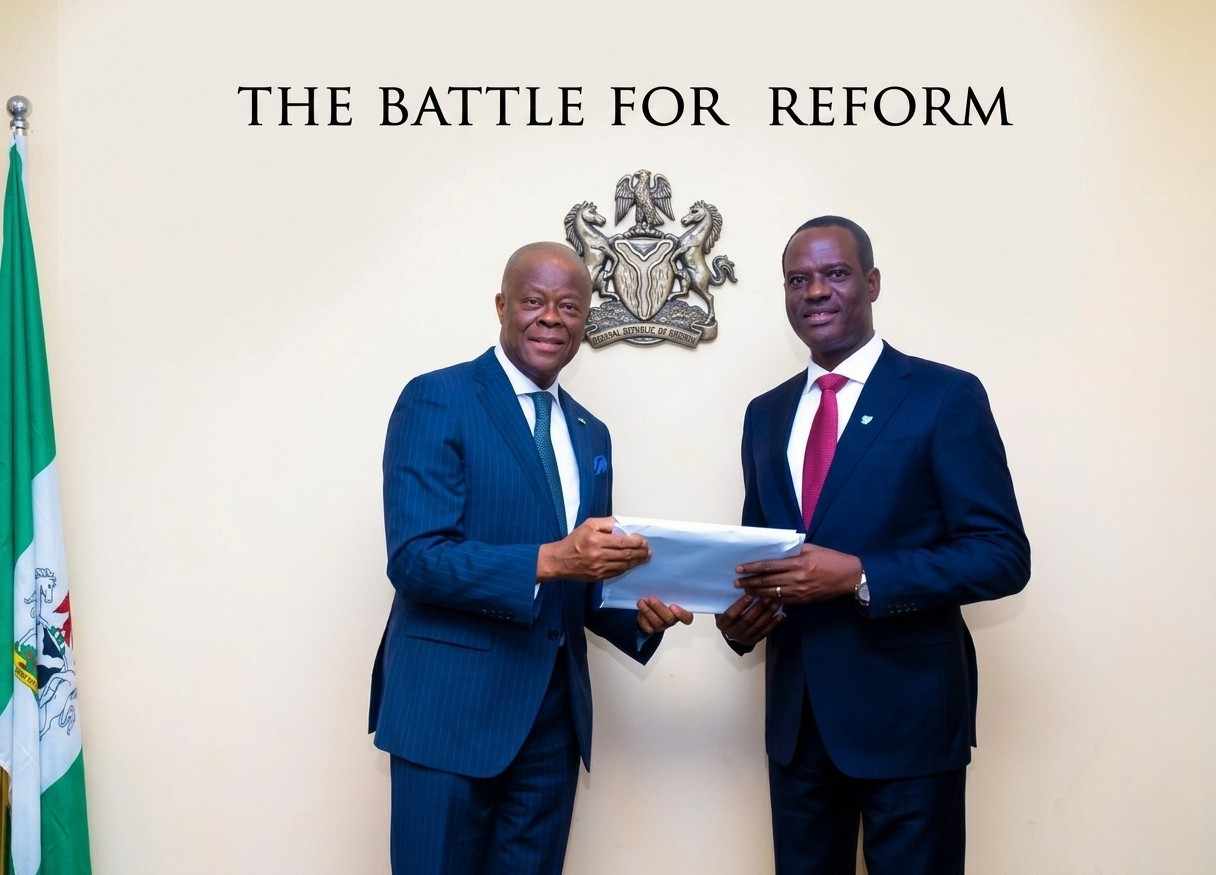
The departure of Wale Edun marks the end of the “Architectural Phase” of Nigeria’s economic reforms—a period defined by the painful removal of subsidies and the dismantling of the CBN’s money-printing machine. As Taiwo Oyedele officially takes the oath of office as the Minister of Finance and Coordinating Minister of the Economy, Nigeria enters the “Extraction Phase.” The mandate given to Oyedele by the Presidency is as clear as it is daunting: he must find ₦40.7 trillion in revenue for the 2026 fiscal year, or watch the administration’s “Renewed Hope” agenda collapse under the weight of the ₦159 trillion debt shadow.
Oyedele, the man who spent the last two years chairing the Presidential Committee on Fiscal Policy and Tax Reforms, is no longer just a consultant providing recommendations. He is now the “Chief Revenue Officer” of a nation in a fiscal emergency. His appointment signals a fundamental pivot in the Villa’s strategy: they have stopped trying to shrink the government to fit the revenue; they are now attempting to expand the revenue to fit the government.
The Architecture of the 40 Trillion Target
To understand the scale of the “Oyedele Gamble,” one must look at the numbers. In 2024 and 2025, Nigeria struggled to cross the ₦15 trillion mark in actual non-oil revenue. Oyedele’s ₦40.7 trillion target represents a nearly 170% increase in performance. For any other technocrat, this would be viewed as a mathematical impossibility. But Oyedele’s “Waza” (insider secret) is based on two pillars: Data Consolidation and Enforcement Automation.
Our investigative team at the “Amina” desk has analyzed the new “Integrated Revenue Portal” (IRP) that Oyedele began designing before his promotion. The goal is to collapse over 60 different federal and state taxes into a single, digitally tracked “Unity Tax” system. By leveraging the Bank Verification Number (BVN) and National Identification Number (NIN) linkages, the Ministry of Finance plans to automatically flag “tax-to-lifestyle” discrepancies. If you are flying business class or purchasing luxury property in Lagos, the “Oyedele Taxman” will know if your declared income matches your spending.
The Informal Sector: The Final Frontier
The most controversial part of the Oyedele mandate is the “Grassroots Extraction.” For decades, the informal sector—comprising nearly 80% of Nigeria’s workforce—has operated largely outside the tax net. Edun avoided this sector to prevent social unrest, but Oyedele has signaled that the “Spectator Era” is over.
The strategy involves a “Digital Toll” system. By integrating tax collection into mobile data purchases, electricity payments, and digital banking transactions, the government aims to collect small, frequent amounts from millions of citizens who previously paid nothing to the central treasury. The risk, however, is immense. Investigative reports from market associations in Onitsha and Kano suggest that any attempt to aggressively tax the “survival economy” of the informal sector could trigger the very social instability that the “Supplementary Budget” was intended to prevent.
The Political Clock and the 2027 Horizon
Why the rush? The answer lies in the 2027 political calendar. The Presidency knows that it cannot go into an election year with a stalled economy and a 74% debt-service ratio. They need “Voter Projects”—roads, rail, and social handouts—and they need them visible by Q1 2027.
Oyedele has been given a 24-month “window of aggression.” He is expected to front-load revenue collection in 2026 to provide the “Stimulus Cash” needed for 2027. Our Villa sources indicate that Oyedele’s performance will be judged not by his macroeconomic speeches, but by the “Treasury Single Account” (TSA) balance at the end of every quarter. If the ₦40.7 trillion target isn’t hit, the administration will be forced back to the international markets to borrow at even higher interest rates, effectively nullifying everything Edun worked for.
The Human Cost of the Ledger
The investigative reality of the “Oyedele Era” is that it will be the most “intrusive” fiscal period in Nigerian history. The transition from Edun’s “Fiscal Guardrails” to Oyedele’s “Revenue Aggression” means that the government is moving from being a “Manager of Debt” to a “Collector of Wealth.”
For the average Nigerian, the “Oyedele Gamble” feels like a pincer movement. On one side, the removal of subsidies has increased the cost of living; on the other, the new tax regime will decrease disposable income. The success of this era depends on a “Trust Dividend” that is currently in short supply. If Nigerians see their taxes being translated into working hospitals and motorable roads, Oyedele will be remembered as the man who saved the republic. If the ₦40.7 trillion is swallowed by the “Administrative Black Hole” of Abuja, he will be remembered as the man who taxed a struggling nation into a standstill.
Closing the Autopsy
The 5-part saga of the Edun-Senate-Presidency standoff reveals a nation at a crossroads. Wale Edun was the “Brake Man” who stopped the train from flying off the cliff of hyperinflation. Taiwo Oyedele is now the “Engine Man” tasked with finding the fuel to move the train forward.
The ₦159 trillion debt is still there. The 2026 budget discrepancies are still there. But the philosophy has changed. Nigeria has moved from the era of “We don’t have money” to the era of “We will find the money in your pockets.” As the sun sets on the Edun era and rises on the Oyedele mandate, the only certainty is that the ledger must be balanced—and one way or another, the Nigerian people will be the ones to balance it.
Leave a Reply