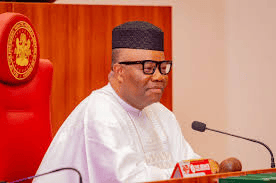
Akpabio declares three Senate seats vacant |
When Senate President Godswill Akpabio struck the gavel on Tuesday, it wasn’t to pass a new tax or debate a loan. It was a somber ritual. A constitutional necessity. A reminder that the “10th Senate” is already losing its shape. Three seats—Enugu North, Nasarawa North, and Rivers South-East—have been declared vacant. Now the question is simple: Will these upcoming by-elections bring fresh solutions, or are we just replacing names in a stagnant system?
The Ghosts of the Red Chamber
In my years covering the National Assembly, I’ve seen this script played out many times. Section 68 of the 1999 Constitution (as amended) is clear: when a lawmaker passes, the seat must be declared vacant. But as I look at these three districts, I remember the faces of those who sat there. At the centre of this development are:
-
Enugu North: A district searching for its voice in a changing South-East.
-
Nasarawa North: A key gateway where representation often determines local security.
-
Rivers South-East: A high-stakes political battleground where “vacant” usually means “the drums of war are starting.”
The 30-Day Race
On paper, the Independent National Electoral Commission (INEC) is now on a clock. According to the Senate President’s mandate, fresh polls must happen within 30 days. But the data suggests that “30 days” in Nigerian election time is a heavy lift:
-
The Cost of Democracy: Previous off-cycle senatorial by-elections have cost the taxpayer billions in logistics and security. In 2026, with the current inflation, these three seats won’t be “cheap” to fill.
-
Voter Apathy: Historically, by-elections in Nigeria struggle to hit 20% voter turnout. People often ask, “Why queue under the sun for one man when the Senate itself feels so far away?”
-
The Legislative Gap: Since the demise of these senators, these three districts have had zero representation during critical debates on the $6bn loan request and the new minimum wage implementation.
From a veteran’s perspective, this suggests: A seat can be filled in 30 days, but the vacuum left in the hearts of the constituents takes much longer to heal.
The Reality in the Districts
Now step outside the Senate chambers in Abuja. Talk to:
-
A market woman in Nsukka (Enugu North) who doesn’t know her senator is gone, but knows her road is still broken.
-
A youth leader in Rivers who is already being approached by “godfathers” to mobilize for a candidate he doesn’t believe in.
-
A farmer in Akwanga (Nasarawa North) who just wants someone—anyone—to speak up about the security of his crops.
Then state what’s happening in real life: The politicians are calculating “zoning” and “party loyalty,” while the people are calculating “survival.” That’s not just a statistic. That is the disconnect of the 10th Senate.
The Core Tension
Here is the real tension:
-
The Law: Requires the seat be filled to ensure “equality of representation.”
-
The People: Feel that even when the seat is full, their voices are rarely heard. Policies fail when we care more about filling the chair than fulfilling the mandate.
The Final Word
This is not just a routine announcement. But it is a test for INEC and the political parties. It is the Replacement Phase.
Politics is not judged by the gavel of the Senate President. It is judged by the service of the person who wins the seat. Until we see candidates who represent the pain of the street and not the pocket of the party, the “Red Chamber” will remain a hall of echoes.
The chairs are empty for now. The campaigns are starting. But for the people of Enugu, Nasarawa, and Rivers, The search for a true champion continues.
Leave a Reply