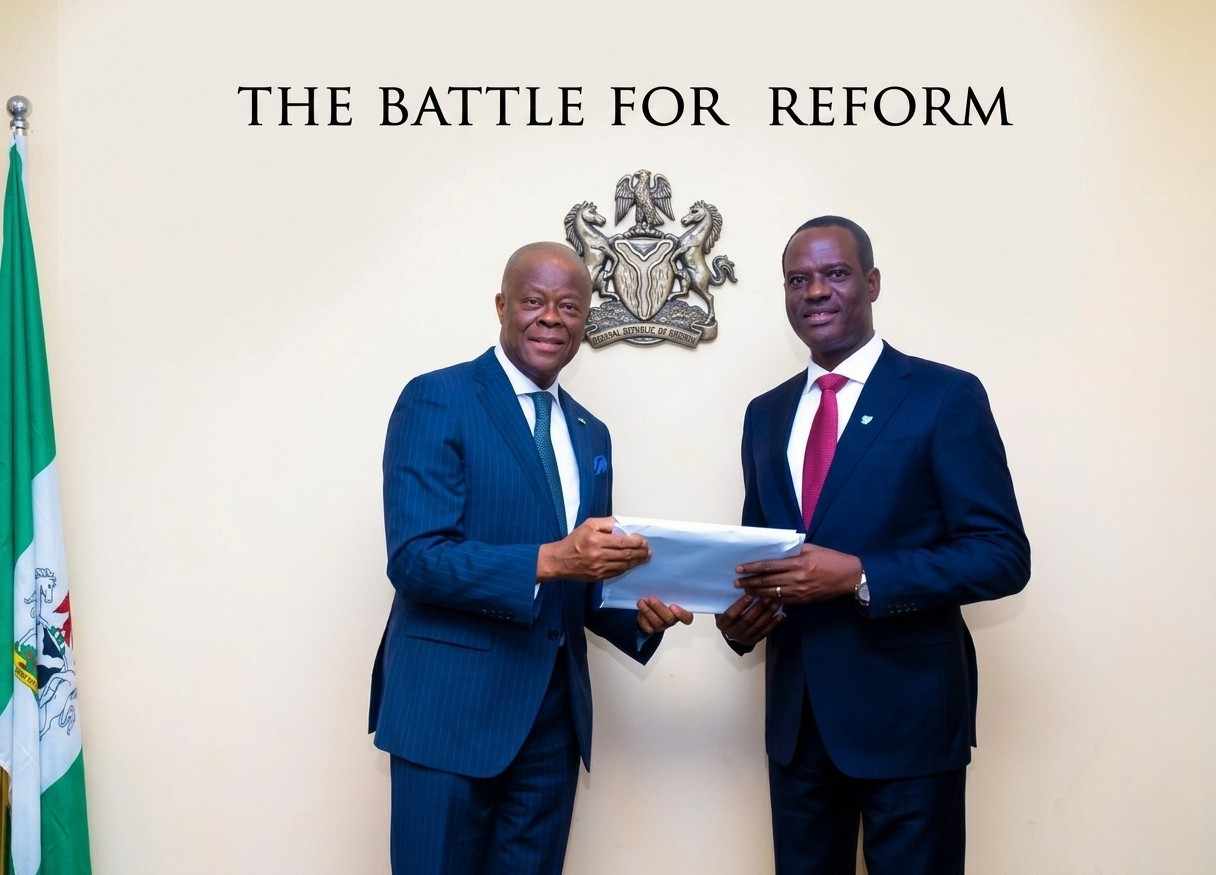
While Part 1 of this series was about a public disagreement over future projections, this Part 2 is about the private war over immediate survival. By late 2025, the Nigerian economy was functioning like a vehicle running on fumes, and the man holding the jerrycan of fuel was Wale Edun. But instead of pouring it in, he decided to dismantle the pump. This “pump” was the Ways and Means advances—a mechanism where the Central Bank of Nigeria (CBN) essentially printed money to cover government budget deficits.
For nearly a decade, the Nigerian government had bypassed traditional revenue generation by leaning on the CBN. By the time Edun took full control of the steering wheel, the “overdraft” had ballooned to a staggering ₦30 trillion. It was a financial addiction that had fueled inflation, devalued the Naira, and made Nigeria a cautionary tale in international boardrooms. Edun’s decision to go “cold turkey” on this addiction wasn’t just a policy shift; it was a declaration of war against the established political order in Abuja.
The Death of the “Magic Money” Machine
In a series of closed-door meetings between October 2025 and January 2026, Edun reportedly issued a directive that sent shockwaves through the federal cabinet: the government would no longer spend money it had not earned. He insisted on strict adherence to the Section 38 of the CBN Act, which limits federal borrowing from the apex bank to 5 percent of the previous year’s actual revenue.
This meant that the ₦2 trillion to ₦3 trillion monthly “top-ups” that previous administrations used to pay salaries and fund “emergency” projects vanished overnight. The impact was immediate and brutal. For the first time in years, several Ministries, Departments, and Agencies (MDAs) found their accounts “dry” as early as the second week of the month. The “liquidity desert” had arrived in the heart of the federal capital.
The Silent Mutiny in the Cabinet
While the international community—specifically the IMF and the World Bank—applauded Edun’s “fiscal purity,” a silent mutiny was brewing within the Presidency. Our “Waza” (insider truth) suggests that at least six powerful ministers and a handful of influential presidential aides began a coordinated campaign to “soften” Edun’s stance. They argued that his rigid adherence to fiscal rules was “politically suicidal.”
The logic of the politicians was simple: “People don’t eat fiscal discipline.” They pointed to stalled road projects in the Southeast, unpaid contractors in the North, and the slowing pace of the “Renewed Hope” infrastructure agenda. In their view, Edun was acting like a surgeon who was so focused on the technical success of the operation that he was oblivious to the fact that the patient was dying of starvation on the table. One senior official reportedly told the President in a late-night session, “Wale is building a perfect economy for a country that will no longer have a government if we don’t start spending.”
The Zero-Implementation Crisis
By the end of the first quarter of 2026, the data from the Budget Office told a harrowing story. Capital implementation—the actual release of funds for building things—was at a near-standstill. Edun had successfully stopped the “money printing,” but the “revenue tracking” hadn’t caught up fast enough to fill the void. This created a vacuum where government contractors, many of whom were the primary drivers of middle-class employment, began laying off workers by the thousands.
The “investigative under-read” here is that this wasn’t just an accidental slowdown. Edun was using the liquidity squeeze as a tool to force MDAs to undergo a “fiscal audit.” He refused to release funds to any ministry that could not account for its previous year’s expenditure. In his mind, he was cleaning the Augean stables of Nigerian corruption; in the minds of the political class, he was “The Man Who Locked the Safe” and threw away the key.
The IMF’s Darling vs. Abuja’s Outcast
Throughout this period, Edun’s stature abroad reached an all-time high. In London and New York, he was the “Technocrat King” who had finally brought sanity to Nigeria’s wild-west finances. This external support was his primary shield. As long as he had the backing of global creditors, the Presidency was hesitant to move against him for fear of a market sell-off or a credit rating downgrade.
However, domestic pressure is a different beast entirely. As the 2026 fiscal year progressed, the disconnect between the “Macro” (international approval) and the “Micro” (local liquidity) became a chasm. The Senate, sensing the cabinet’s frustration, used the “Ways and Means” issue as a cudgel during every public hearing. They demanded to know why the government was “starving” the people to please “faceless bankers in Washington.”
The Birthday Deadline
By March 2026, the standoff reached its breaking point. The Presidency was caught between two irreconcilable forces: Edun’s refusal to restart the CBN overdrafts and the cabinet’s demand for a “Stimulus Package” to save their political futures ahead of 2027. It was during this month that the timeline for Edun’s “honorable retirement” was allegedly mapped out.
The “Ways and Means” war was won by Edun in the sense that the ₦30 trillion debt was eventually “securitized” (turned into long-term bonds), but he lost the political war. He had proven that he could stop the printing press, but he hadn’t yet proven that he could start the economy without it. His exit wasn’t just about his age; it was about the Presidency’s need for a “Revenue General” who could find a middle ground between printing money and starving the government.
As we will see in Part 3, the “Health Resignation” on his 70th birthday was the only way to end a cabinet war that had brought the Nigerian government to a fiscal standstill. The man who saved the Naira from total collapse was, in the end, sacrificed to save the political peace.
Leave a Reply