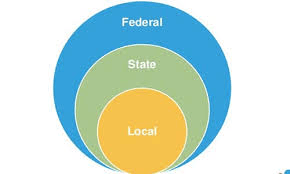
When the Supreme Court delivered its landmark judgment on Local Government Autonomy in July 2024, it was hailed as a second independence. A legal earthquake. A win for the grassroots. The death of the “Joint Account.” Now, in March 2026, the question is simple: If the law says the money belongs to the Local Governments, why are governors still holding the remote control?
The Power Tug-of-War
Nigeria’s governance is a three-story building where the landlord on the top floor (Federal) and the tenants on the ground floor (Local) rarely speak because the middleman (State) has locked the staircase. We call it “Federalism,” but in practice, it is often a bottleneck. At the centre of this issue are:
- Constitutional Contradictions: Section 7 guarantees local councils, but Section 162 gives States the power to “legislate” their finances.
-
The Caretaker Culture: Governors frequently bypass elections to appoint “Caretaker Committees”—loyalists who won’t question where the money goes.
-
Implementation Inertia: A court ruling is just paper until a bank account is actually credited.
The Autonomy Gap
On paper, the push for decentralized funding looks like a revolution, but the 2026 data reveals a “compliance crawl”:
- The 19-Month Stall: As of January 2026, 19 months after the Supreme Court ruling, the majority of the 774 LGAs still do not receive 100% of their allocations directly. States like Lagos, Imo, and Kwara are still navigating “joint” structures for LCDAs and administrative costs.
-
The Revenue Miss: The Minister of Finance, Wale Edun, recently confirmed that while federal revenue targets for 2025 were met, sub-national (State) performance lagged significantly, with a projected ₦30 trillion revenue gap looming over the 2026 fiscal year.
-
Fiscal Transparency: According to the World Bank’s SFTAS 2025 report, while all 36 states now publish audited financial statements, only 17 states have achieved 80% coverage in their Treasury Single Account (TSA) systems.
From a macro perspective, this suggests: Abuja is tightening its belt, but the States are still wearing oversized robes.
Reality on the Ground
Now step outside the data. Talk to:
- A Local Government Chairman who has the title but has to beg the Governor’s Chief of Staff for funds to fix a single borehole.
-
A Primary School Teacher whose salary is “guaranteed” on paper but delayed because the State-Local Joint Account is “under reconciliation.”
-
A Market Woman paying “daily tickets” to three different levels of government, none of whom have cleared the drainage in front of her stall.
Then state what’s happening in real life: The Supreme Court freed the money, but the political machinery hasn’t surrendered the keys. That’s not just a statistic. That is a hijacked democracy.
The Core Tension
Here is the real tension:
- The Federal Level: Is pushing “Executive Order 9” (February 2026) to enforce direct remittances and fiscal fidelity.
-
The State Level: Argues that they provide the “infrastructure and security” that LGAs cannot handle alone, justifying their continued grip on the purse strings. Policies fail because Abuja legislates, but the States dictate.
Pressure Points
There are three key areas under scrutiny:
- The Electoral Loophole As long as State Independent Electoral Commissions (SIECs) are controlled by Governors, “local” elections will always produce 100% wins for the ruling party in that state.
-
The “LCDA” Complexity In states like Lagos, federal allocations must be split between 20 constitutionally recognized LGAs and 37 Local Council Development Areas. This creates a mathematical and political nightmare.
-
Debt Overhang Many states have “deductions at source” for old loans. When these hit the LGAs, there is often nothing left but stories.
The Verdict
This is not a lack of law. But it is a resistance of power. It is the Compliance Struggle.
Policies are not judged by the judgment of the Supreme Court. They are judged by the autonomy of the local council. Until the money hits the LGA account without a “stopover” at the State House, the grassroots will remain dry.
(the last part of this series is under way….)
Leave a Reply