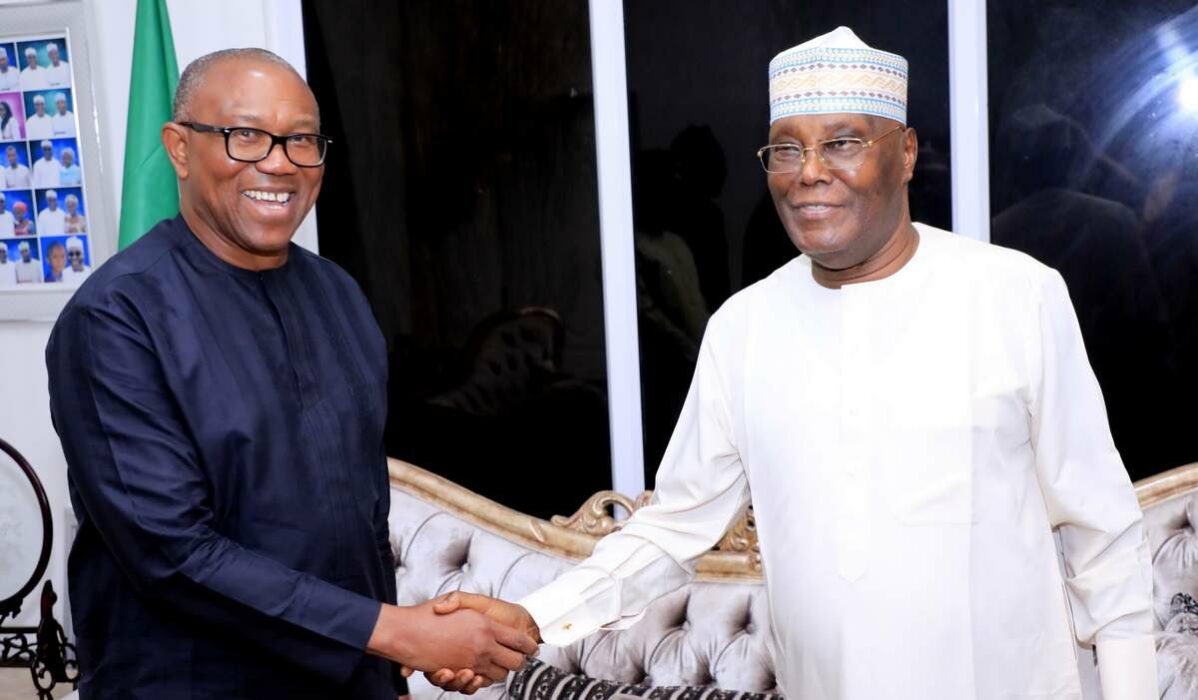
The countdown to Nigeria’s 2027 presidential election has begun, and already, a major headache is brewing for opposition parties. The African Democratic Congress (ADC) has openly admitted its deep worry that two strong contenders, former Vice President Atiku Abubakar and the Labour Party’s popular candidate, Peter Obi, might not join forces. This potential split, according to Mallam Bolaji Abdullahi, ADC’s spokesperson, is a ‘conundrum’ and a serious challenge that could weaken the opposition’s chances against the ruling party, the All Progressives Congress (APC).
Speaking on Arise TV, Abdullahi made it clear that while this situation is a big deal, he wouldn’t call it the ‘greatest threat’ to our democracy. However, he didn’t mince words about the fact that it’s a tough knot to untie, a real challenge, and something the ADC is truly concerned about. For many Nigerians hoping for a strong alternative in 2027, the thought of Atiku and Obi going separate ways is indeed a troubling one, as it could mean splitting votes and making it easier for the incumbent party to stay in power.
To properly understand why this potential split is causing so much worry, we need to look back at the 2023 general elections. Before 2023, the political scene in Nigeria was mainly dominated by two big parties: the APC and the Peoples Democratic Party (PDP). However, Peter Obi’s emergence as the Labour Party’s presidential candidate brought a new ‘third force’ into play. Obi, with his message of prudent management and anti-corruption, quickly gained massive support, especially among young people and those in urban areas, who are now famously called the ‘Obidients.’
Atiku Abubakar, on the other hand, is a veteran politician, a former Vice President, and a consistent presidential candidate for the PDP. He commands significant support across various parts of the country, especially in the North. In the 2023 election, both Atiku and Obi ran strong campaigns, coming second and third respectively. Many political observers and even ordinary Nigerians believed that if Atiku and Obi had found a way to work together, perhaps forming a grand coalition, they might have presented a more formidable challenge to the APC and its eventual winner, President Bola Ahmed Tinubu. This is the background that makes the ADC’s current concern so relevant.
Now, with 2027 on the horizon, the talk of an Atiku-Obi alliance has been lingering. The idea is simple: combine their strengths, their individual support bases, and their political structures to create a ‘mega party’ or a unified front that can truly compete for the presidency. But as Mallam Abdullahi highlighted, getting these two political heavyweights to team up is proving to be a ‘conundrum.’ Both men have strong ambitions and loyal followers, and convincing one to step aside for the other, or to accept a running mate position, is always a delicate dance in Nigerian politics, often involving intense ‘horse-trading’ and negotiations among ‘power brokers’ and ‘stakeholders.’
Despite these big national political calculations, Abdullahi revealed that the ADC itself is currently focused on building its house. He explained that at this stage, the party is not even discussing who its own presidential candidates will be. Instead, their priority is on ‘strengthening its national structures’ and ‘developing capacity’ for a strong showing in 2027. What does this mean in simple terms? It means the ADC is busy working to establish a proper presence in all 36 states of the Federation and the Federal Capital Territory. This involves setting up functional party offices, recruiting dedicated members at the ‘grassroots’ level, training party officials, and making sure the party is strong and visible across the country. They want to be ready to compete, not just at the presidential level, but also for governorships, Senate seats, House of Representatives, and State Assembly positions.
Abdullahi stressed, “We have so much work to do, to establish our presence, to be in a position to contest elections in all the 36 states of the Federation and the FCT. So, this has preoccupied us. But we know that is an issue we have to deal with.” This shows that while the Atiku-Obi dynamic is a concern, the ADC understands that its own survival and relevance depend on internal strengthening. A party cannot effectively participate in national conversations or coalitions if its own foundation is weak.
Looking ahead, Abdullahi also touched on how the ADC plans to pick its own presidential candidate. He said the party would first try to achieve a consensus. This means getting all potential aspirants and party leaders to agree on one candidate without going through a competitive primary election. Consensus is often preferred by parties to avoid the internal rifts and financial costs associated with primaries. However, if reaching a consensus proves impossible, the party will then ‘throw open’ the presidential ticket, meaning anyone interested can contest, and the party members will vote to pick their flagbearer. This ensures a democratic process if consensus fails. Abdullahi also reminded everyone that the presidential race isn’t just about Atiku and Obi; other capable Nigerians will also be interested, and parties must make room for them.
Furthermore, the ADC spokesperson confirmed that his party is still actively talking with other political parties to form an even stronger coalition before the 2027 election. This suggests a broader understanding among smaller parties that unity might be their best bet against the established political giants. Historically, successful opposition movements in Nigeria, like the formation of the APC from several legacy parties in 2013, have relied on such mergers and alliances. The goal is to pool resources, votes, and influence to become a formidable force capable of unseating an incumbent.
In conclusion, the worries expressed by the ADC highlight the complex political calculations already underway for the 2027 presidential election. The potential failure of Atiku Abubakar and Peter Obi to team up represents a significant challenge for Nigeria’s opposition, risking a fragmentation of votes that could inadvertently benefit the ruling party. While the ADC is focusing on building its internal strength, it remains part of the ongoing conversation about broader opposition unity. The coming months will likely see intense negotiations, strategic realignments, and political ‘jostling’ as parties and candidates position themselves for what promises to be a highly competitive and crucial election. The desire for a strong, united opposition remains a key topic for many Nigerians who are eager for genuine change and alternative leadership.
Leave a Reply