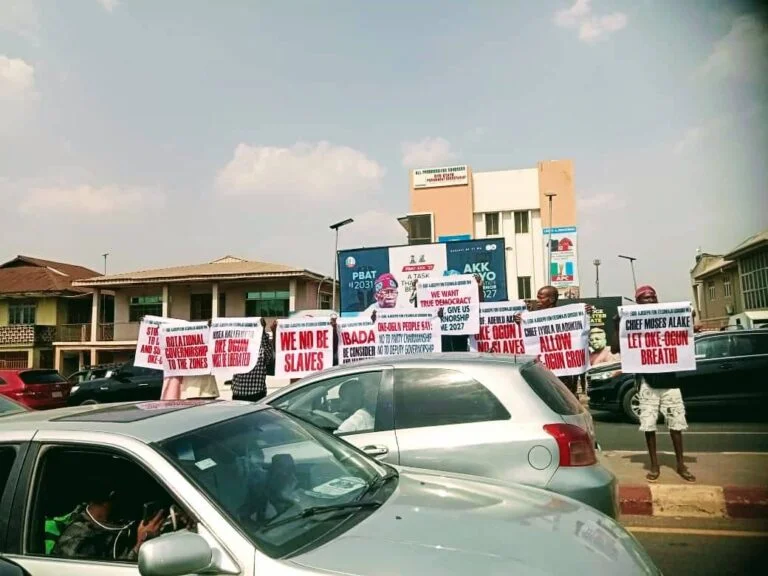
The maneuvering for the 2027 gubernatorial race in Oyo State has ignited early friction within the All Progressives Congress (APC), with a significant voting bloc rejecting offers of party leadership in favor of executive power. On Monday, stakeholders from the Okeogun region mobilized at the party headquarters in Ibadan to protest against the reported zoning of the State Chairmanship position to their district. The demonstration, organized by the socio-cultural group “Egbe Ajosepo fun Itesiwaju Gbogbo Wa,” signals a sophisticated understanding of political zoning arithmetic, where holding the party gavel often disqualifies a region from producing the state governor.
At the heart of the unrest is the suspicion that the APC leadership is attempting to placate the zone with a less influential administrative title to clear the path for another zone to secure the gubernatorial ticket. Dauda Olaifa, the leader of the agitation, argued that accepting the chairmanship would be a strategic error, as political convention dictates that the party chairman and the governor cannot emerge from the same zone simultaneously. This pushback comes shortly after the party announced an ad-hoc committee led by Fatai Ibikunle to manage the distribution of executive offices across the state’s 33 local government areas.
The protesters characterized the recurring offer of the chairmanship to Okeogun as “political tokenism” rather than genuine inclusion. Historical data cited by the group suggests that since 1999, the chairmanship role has been disproportionately domiciled in Oyo North across both the APC and the PDP. They argue this pattern is a containment strategy designed to leverage the zone’s ten local governments—the second largest bloc after Ibadan—to install governors from other regions. Having served as kingmakers for decades, the zone is now demanding the executive seat, asserting that they have qualified aspirants ready for the job.
The implications for the APC are severe if the demands are ignored. The group explicitly threatened to swing their voting weight behind any political party that fields a candidate from Okeogun, regardless of prior affiliations. Referencing power rotation models in neighboring southwestern states like Osun, Ogun, and Ekiti, stakeholders emphasized that equitable power-sharing is a necessity for stability. As the APC attempts to reorganize its internal structure, it faces a dilemma: continue with traditional zoning arrangements and risk alienating a critical voting bloc, or overhaul the power equation to accommodate the gubernatorial ambition of the Okeogun people.
Leave a Reply